Unleash Your Creativity with Freehand Doodle Lines: A Versatile Dingbats Font
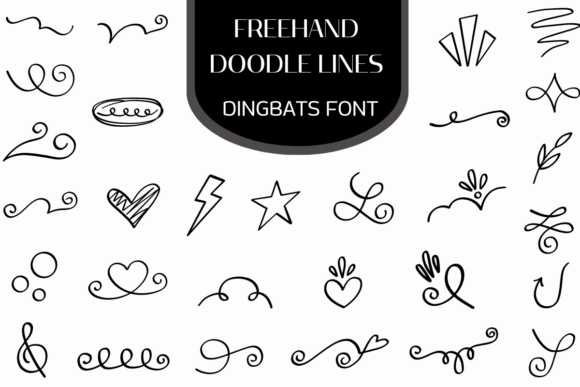
Sometimes, a design just needs a little something extra—a touch of personality that feels human and authentic. You might be working on a project and think, “This looks good, but it feels too digital, too perfect.” That’s where the charm of hand-drawn elements comes in. Freehand Doodle Lines is a cool dingbats font designed to inject that organic, sketchy feel directly into your work with just a keystroke. It’s not a traditional font for writing sentences; it’s a toolbox of decorative line art, borders, and doodles that you can use to frame, highlight, and embellish your creative projects.
What Exactly is a Dingbats Font Like Freehand Doodle Lines?
For those unfamiliar, a dingbats font doesn't contain letters or numbers. Instead, each key on your keyboard is mapped to a unique symbol, shape, or illustration. When you install Freehand Doodle Lines and type a letter, you won't see an "A" or a "B"—you'll see a whimsical squiggle, a looping border, a cluster of dots, or a playful arrow. This approach is incredibly efficient for creators. You don't need to search for separate image files or learn complex software tools to add these elements. If you can type, you can doodle.
Where and When to Use Freehand Doodle Lines
The real value of this font lies in its application. It shines in scenarios where you want to break away from rigid, corporate aesthetics and connect with an audience on a more personal level. Think about situations where warmth, creativity, and a handcrafted vibe are more important than sterile precision.
Imagine you're a blogger or content creator designing social media graphics for an Instagram story. A standard line divider feels boring. By using Freehand Doodle Lines, you can replace that divider with a quirky, dashed line or a series of tiny stars, making your post feel more engaging and unique. It helps your content stand out in a crowded feed, signaling that a real person put thought into the visual presentation.
For small business owners and entrepreneurs, especially those in creative fields like bakeries, boutiques, or handmade crafts, this font is a secret weapon for branding. Use it to create custom borders for thank-you cards, add playful accents to product packaging labels, or design eye-catching flyers for a local market. The hand-drawn style communicates care and attention to detail, which can make customers feel more connected to your brand story.
For Digital and Print Design
Graphic designers and freelancers can integrate these doodle lines into a wide range of deliverables. Need to quickly mock up a newsletter header? Type a few characters from the Freehand Doodle Lines font to create a custom underline or corner flourish. Designing a workshop workbook for an educator? Use the doodles as bullet points for lists or as section breaks to make learning materials more approachable and less intimidating for students of all ages.
The versatility extends to personal projects too. Hobbyists creating scrapbook pages or personal journals can print out sheets of these doodles to cut and paste, adding authentic hand-drawn accents without needing strong drawing skills. Parents can liven up a chore chart or a birthday party invitation with simple, fun doodles that kids will love.
Considerations Before You Dive In
While Freehand Doodle Lines is a fantastic resource, a little planning ensures you get the best results. First, explore the entire character map. Since it's a dingbats font, you'll need to see what symbols are assigned to which keys. Most font creators provide a cheat sheet or you can use your system's character viewer to browse the options. This prevents guesswork and lets you plan your designs more effectively.
Second, think about context. The very quality that makes these lines appealing—their rough, sketchy nature—might not be the right fit for every project. They work beautifully for creative, casual, and educational content. However, for a formal legal document or a high-end luxury brand aiming for sleek minimalism, a more refined graphic element might be appropriate. The goal is to match the tool to the tone of your message.
Finally, consider your color palette and scale. These doodles often look best in a single, solid color that complements your design. You can easily change the color of the font just like you would with text. Experiment with the size, too. A line that looks perfect as a subtle accent in a 12-point size might become a bold, dominant graphic when scaled up to 72 points. Play around to see what works for your specific layout.
Connecting Features to Real-World Outcomes
The primary feature of Freehand Doodle Lines—its collection of pre-drawn, instantly accessible line art—directly solves a common creative problem: the need for quick, stylistically consistent decorative elements. Instead of spending time searching for or drawing individual doodles that match, you have a cohesive set at your fingertips. This consistency is key for maintaining a professional look, even in a playful design.
For marketers, this can translate to higher engagement. A social media ad with a hand-drawn arrow pointing to a "Learn More" button can feel more like a friendly suggestion than a hard sell, potentially increasing click-through rates. For publishers, using these lines as decorative elements in a book's chapter headers or page footers can enhance the reader's experience, adding a layer of visual interest that complements the text.
Ultimately, Freehand Doodle Lines is about adding a human touch in a digital world. It’s a practical, easy-to-use tool that empowers anyone—from the seasoned designer to the enthusiastic hobbyist—to enhance their projects with charm and personality. By understanding its nature as a dingbats font and thoughtfully applying it to the right contexts, you can enjoy the creative results it brings to your work.