About Heart: Evaluating the Chic Calligraphy Font for Design Projects
In the crowded landscape of typography, finding a script font that balances elegance with genuine usability can be a significant challenge. Many decorative fonts sacrifice legibility for style, or they appear dated almost immediately after purchase. About Heart enters this space as a chic calligraphy option that promises a distinct, love-infused aesthetic. For designers, marketers, and creators, the question isn't just whether a font looks beautiful in a preview—it's whether it will perform reliably across various mediums. This analysis explores the practical value of About Heart, examining its design characteristics, ideal applications, and potential limitations to help professionals decide if it deserves a place in their toolkit.
Design Characteristics and Aesthetic Appeal
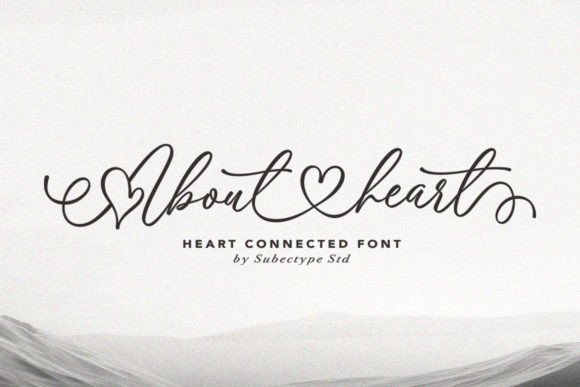
About Heart is categorized as a connected script font, meaning its letters flow into one another to mimic the continuous motion of hand-lettering. What sets it apart is the deliberate "love touch" woven into its design. This isn't merely a marketing phrase; it refers to the subtle, organic variations in stroke weight and the gentle, rhythmic connectivity between characters. The font avoids the overly rigid, mechanical connections that plague many script fonts, instead opting for a more natural, handwritten feel.
The overall style is best described as timeless chic. It doesn't lean into trendy, overly swashed calligraphy that can feel overwhelming. Instead, it maintains a balanced composition. The ascenders and descenders—the parts of letters that extend above the midline (like 'h' or 'l') and below the baseline (like 'g' or 'y')—are crafted with care, providing a graceful silhouette without consuming excessive vertical space. This careful proportioning is a key strength, as it allows the font to be used in contexts where space is at a premium, such as on product packaging or social media graphics, without looking cramped or distorted.
Practical Usability in Real-World Projects
A font's true test is its performance in a real-world workflow. About Heart is designed primarily for display use—headlines, logos, invitations, and branding elements—rather than for long-form body text. In these roles, its connected style shines. When setting a short phrase or a brand name, the letters create a cohesive, unified wordmark that feels personal and crafted. This makes it a strong candidate for wedding stationery, boutique branding, and lifestyle product labels.
However, usability requires more than just aesthetic appeal. Readability at small sizes is a critical consideration. Due to its connected nature and the delicate details that give it charm, About Heart can become difficult to decipher when used at very small point sizes, particularly in digital contexts with lower screen resolutions. It's not the font for fine print or legal disclaimers. Its strength lies in being viewed at a size where its intricate details can be appreciated, typically 24pt and above for print, and a corresponding large size for digital screens.
Another practical aspect is its character set and OpenType features. A professional calligraphy font often includes alternate characters, ligatures (special combined letter pairs), and stylistic sets to provide variety and avoid repetitive letter shapes. While the specific features of About Heart would need to be confirmed in its documentation, a well-designed font in this category should offer at least basic alternates. This allows designers to customize the look—for example, choosing a different 's' or 't' to better fit a specific word—enhancing its flexibility and preventing a static, "fontified" appearance.
Ideal Audience and Application Scenarios
Understanding who benefits most from About Heart is key to its effective use. The font is particularly well-suited for:
- Freelance Designers and Brand Strategists: For projects requiring a personal, heartfelt, or luxurious feel. It works well for creating logos for cafes, bakeries, florists, wellness brands, or any business that wants to convey warmth and authenticity.
- Event Planners and Stationery Designers: The "love touch" makes it a natural fit for wedding invitations, save-the-dates, thank-you cards, and event signage. Its timeless quality ensures designs won't feel dated a few years later.
- Content Creators and Bloggers: For crafting compelling headers on Pinterest graphics, Instagram quotes, or blog post titles that need to stand out and evoke an emotional response. It can add a sophisticated, curated feel to a digital presence.
- Small Business Owners: Especially those in creative or lifestyle industries looking to develop their own marketing materials. Used correctly, it can help establish a distinct brand voice without requiring a custom hand-lettered logo.
A realistic example is a small-batch candle company. Using About Heart for the product name on the label instantly communicates a handcrafted, artisanal quality. Paired with a clean, simple sans-serif for the scent description and details, it creates a balanced and professional hierarchy that appeals to its target market.
Strengths, Limitations, and Long-Term Value
The primary strengths of About Heart lie in its distinctive aesthetic and emotional resonance. It successfully captures a feeling of intimacy and elegance that can elevate a design from merely informative to evocative. Its timeless style also suggests good long-term value; it's less likely to become a typographic cliché compared to more aggressive, trendy scripts.
Regarding limitations, the most significant is the inherent constraint of connected script fonts. As mentioned, readability in small sizes or low-contrast situations is a risk. Designers must pair it thoughtfully with a highly legible complementary font for any supporting text. Furthermore, overuse can diminish its impact. Using it for every headline on a website, for instance, can make the design feel heavy and monotonous. Its power is in selective, impactful application.
In terms of quality and reliability, this depends on the foundry or designer behind the font file. A professionally crafted font will have consistent kerning (the spacing between specific letter pairs), well-designed punctuation, and complete language support. It's always advisable to review the full character map and test the font in your specific design software before committing to it for a major project.
Conclusion: A Considered Choice for Specific Needs
About Heart is not a universal workhorse font, nor is it trying to be. It is a specialized tool designed to inject a specific mood—chic, heartfelt, and timeless—into design projects. Its value is highest when used by professionals who understand typographic hierarchy and can deploy it strategically. For the right project, it offers a compelling combination of beauty and practicality that can help communicate a brand's story effectively. For others, its limitations in readability and potential for misuse mean it should be approached with clear intent. Ultimately, its worth is measured by how well it serves the creator's goal of connecting with their audience on an emotional level.