Planberry: The Handwritten Font for Authentic Digital & Print Projects
There's a certain magic in a handwritten note. It feels personal, immediate, and genuine. In our digital world, that human touch can be a powerful differentiator. This is precisely where a typeface like Planberry finds its purpose. It’s not just another script font; it’s a carefully crafted tool designed to inject warmth, clarity, and a confident personality into your creative work. As a premium font, it moves beyond generic scripts to offer a reliable and versatile solution for professionals and hobbyists alike.
Understanding the Character of Planberry
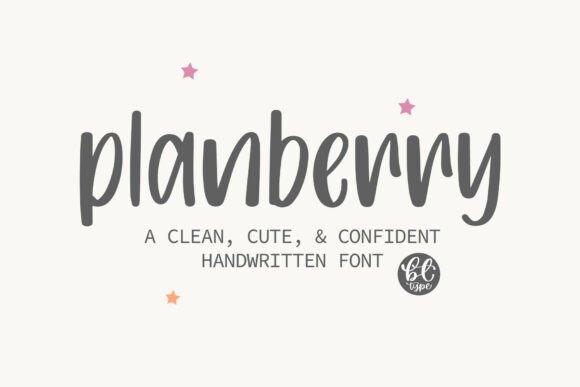
At its core, Planberry is a handwritten font that balances neatness with playful energy. Its letterforms are clean and legible, avoiding the overly casual or chaotic look that can make some script fonts difficult to read in longer passages. The consistency in its baseline and x-height gives it a structured feel, making it suitable for more than just headlines. You’ll notice subtle variations in stroke width that mimic the natural pressure of a pen or stylus, adding authenticity without sacrificing clarity. This makes it a creative font that feels both approachable and polished.
The overall appeal lies in its duality. It possesses the charm of a personal journal entry but carries the confidence needed for commercial applications. It’s the kind of typeface that can make a digital planner feel more intimate or give a brand’s social media graphics a relatable, human voice. Unlike rigid serif fonts or stark sans serif fonts, Planberry operates in a space that prioritizes emotional connection and visual softness.
Where Planberry Truly Shines: Practical Applications
Knowing a font’s personality is one thing; understanding where to deploy it is another. Planberry excels in environments where personal touch and readability are paramount. Its versatility is one of its strongest assets as a design asset.
- Digital Planning & Journaling: This is its native habitat. For iPad journaling apps, digital planners, and bullet journal templates, Planberry feels intuitive. It mimics the experience of writing by hand on a tablet, making the planning process itself more engaging.
- Editorial & Publishing Design: In editorial design, it works beautifully for pull quotes, chapter titles, or section headers in magazines, blogs, and e-books. It draws the eye and breaks the monotony of body text set in a standard serif or sans serif, adding a layer of visual interest.
- Branding & Marketing Materials: For businesses aiming for a friendly, approachable, or artisanal brand identity, Planberry can be a strategic choice. Use it in logo design for a boutique, on packaging design for handmade goods, or across social media graphics to create a consistent, warm tone. It signals that a brand values personal connection.
- Printable Products & Crafting: From wedding invitations and greeting cards to printable stickers and classroom materials for teachers, this font adds a bespoke quality. Its clarity ensures that messages remain easy to read, even at smaller sizes.
Integrating Planberry into Your Design Workflow
Adopting a new font into your toolkit requires more than just liking its look. Practical considerations ensure it enhances, rather than hinders, your projects. Here’s how to approach using Planberry effectively.
Evaluating Project Fit and Readability
First, consider the project’s primary goal. Is it to inform, to persuade, or to evoke a feeling? Planberry is superb for evoking feeling and adding personality. For dense informational text, you would still pair it with a highly legible sans serif font or serif font for body copy. Always test its readability at the intended size and medium. A phrase that looks charming in a headline might become illegible as a tiny caption on a mobile screen. Print a test sheet if the project is for physical goods.
Mastering Font Pairings and Hierarchy
The key to professional use is pairing. Planberry as a display font needs a supporting cast. A clean, geometric sans serif (like Montserrat or Lato) can provide a modern, stable counterpoint. A traditional serif (like Libre Baskerville or Merriweather) can create an elegant, classic contrast. Use Planberry for main headings or key phrases, and its partner for subheadings and body text. This establishes clear visual hierarchy and ensures your design is both beautiful and functional.
Leveraging Included Styles and Licensing
Before purchasing, review the full character set and included styles. Many premium fonts offer alternates, ligatures, or stylistic sets that can further customize the look. For example, you might find different versions of the ‘g’ or ‘s’ that better suit your aesthetic. Crucially, for any commercial project—whether it’s a client’s logo, a product for sale, or marketing materials—you must ensure you have the correct commercial font license. This protects you legally and supports the type designers who create these valuable tools.
In a landscape saturated with cold digital precision, Planberry offers a breath of fresh air. It’s a practical, versatile, and emotionally resonant modern typography solution. By understanding its character and applying it thoughtfully, you can leverage its charm to create work that feels more human, more connected, and ultimately, more engaging. It’s a testament to how the right font can do more than just display words—it can shape an entire experience.